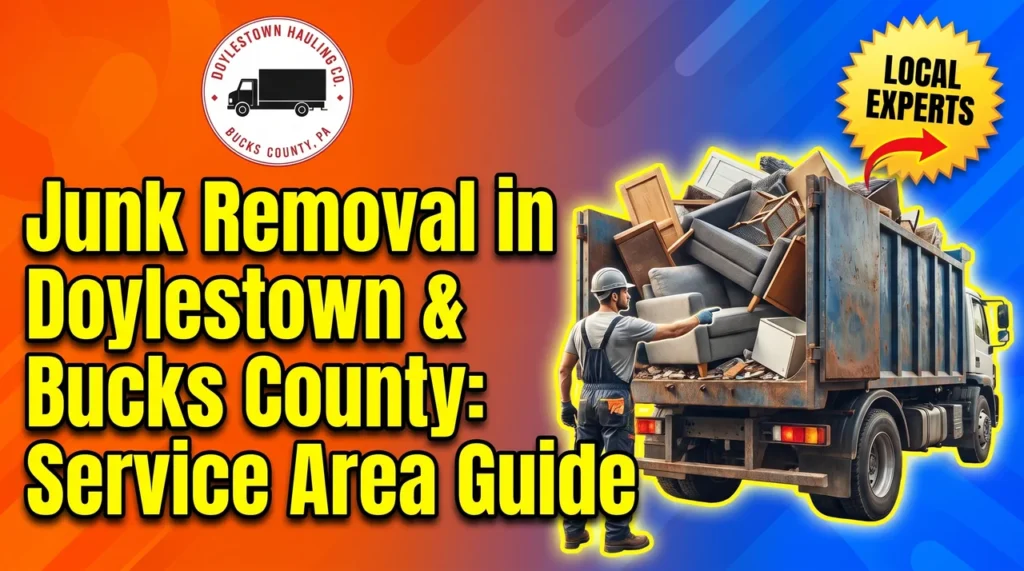
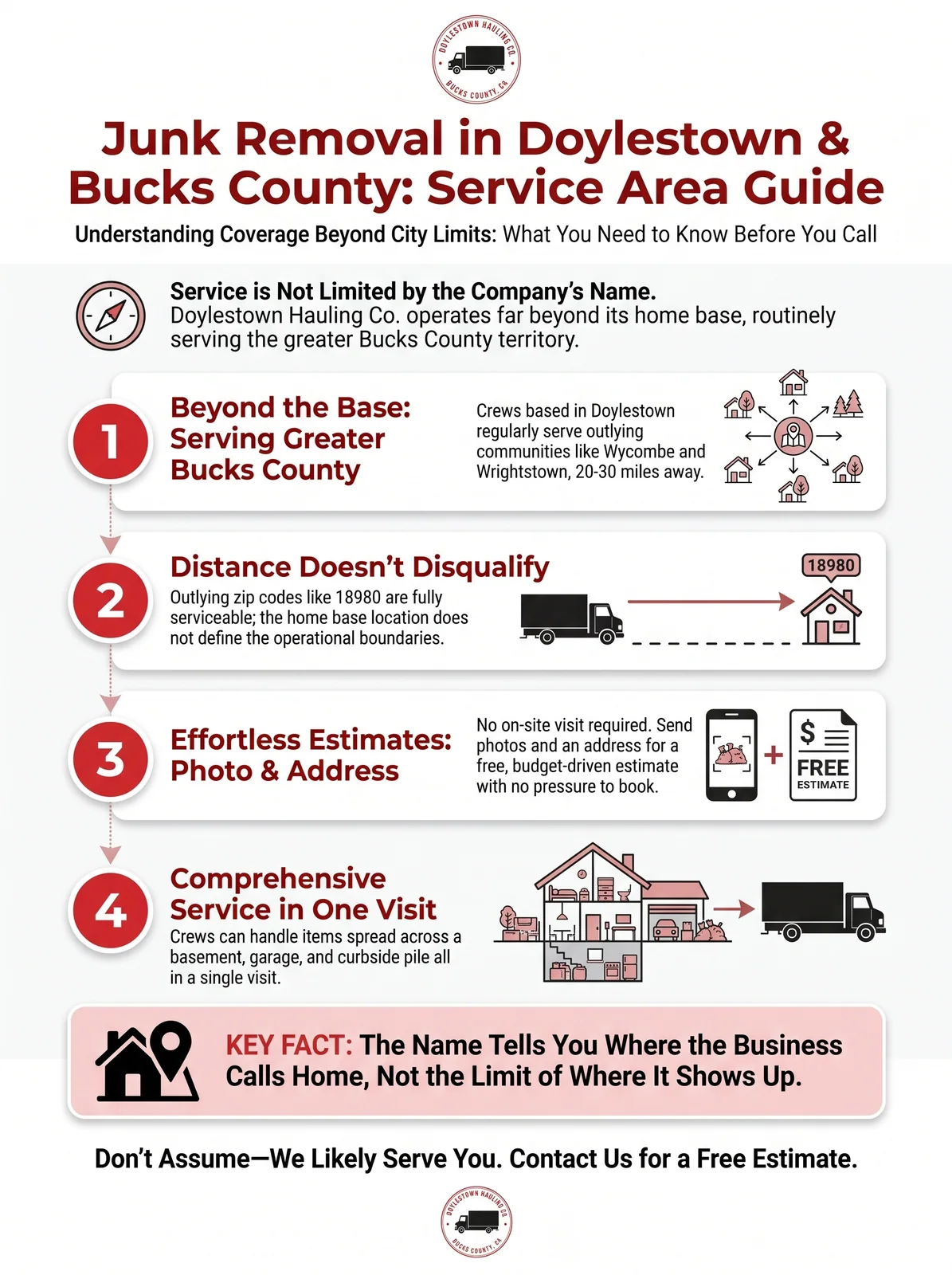
Yes — junk removal service based in Doylestown covers far more than the town itself. Crews built around Doylestown routinely serve outlying Bucks County communities like Wycombe and Wrightstown, even when those towns sit a good distance from the home base. Being 20 or 30 miles out doesn’t put you outside the service area — it just means you’re part of the greater Bucks County territory the company was built to serve.
What you need to know before you call
- A company named for Doylestown can still be based there while regularly serving surrounding towns across greater Bucks County.
- Distance from base doesn’t disqualify a job — outlying zip codes like 18980 (Wycombe/Wrightstown) are still fully serviceable.
- You don’t need to be on-site to get an estimate. Photos and an address are usually enough to get started.
- Estimates are free and budget-driven — you decide whether to book after hearing the number, with no pressure either way.
- Crews can handle items spread across a basement, a garage, and a curbside pile in a single visit.
Does a “Doylestown” junk removal company actually serve my town?
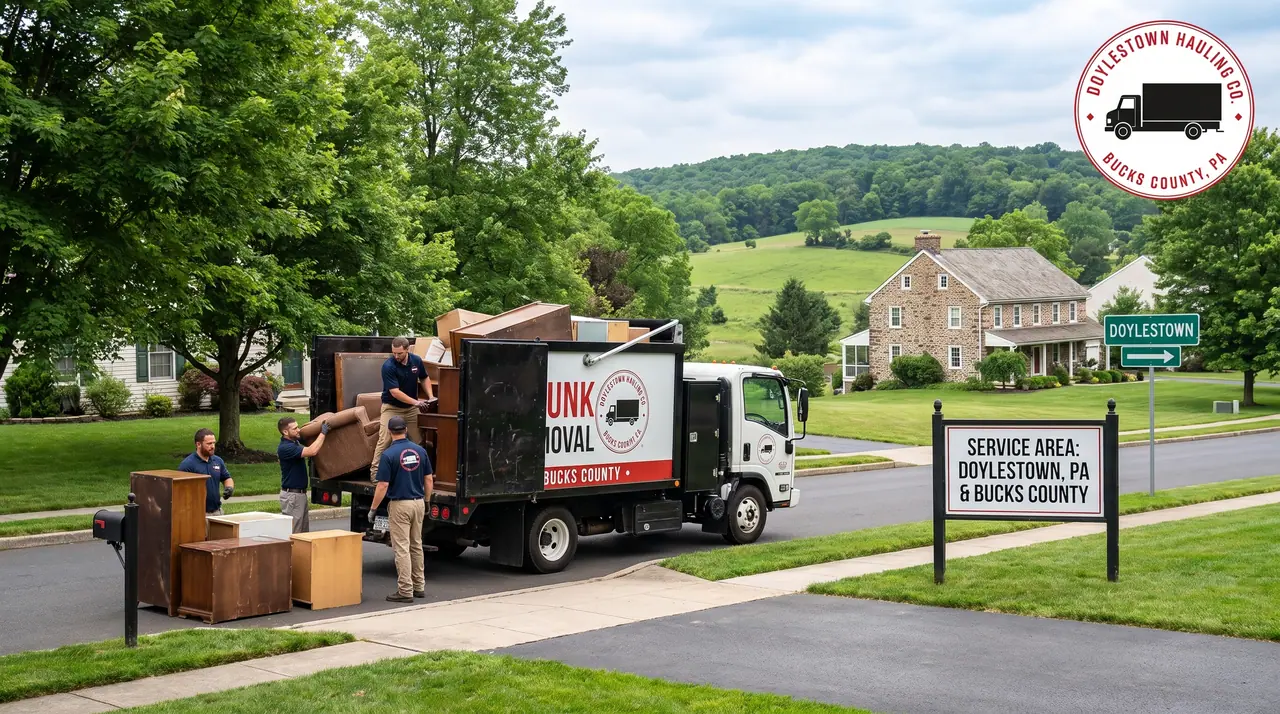
A lot of homeowners assume a company’s name marks the boundary of where it works. That’s a fair assumption — and it’s also usually wrong. Most haulers, including Doylestown Hauling Co., brand around a central hub town but dispatch crews across the wider region every day. The name tells you where the business calls home, not the limit of where it shows up.
If you live in Wycombe, Wrightstown, New Hope, Buckingham, Warrington, or Chalfont, you’re still squarely within a greater Bucks County service area. The crew simply drives to you, the same as it would for a job a few blocks from Doylestown proper. Service quality, pricing philosophy, and the process itself don’t change based on your zip code.
Towns and zip codes typically covered
Bucks County covers a lot of ground, and a hauler built to serve the region typically reaches well beyond the town it’s named for. Here’s a practical way to think about coverage:
| Area | Typical Distance from Doylestown | Commonly Served? |
|---|---|---|
| Doylestown Borough & Township | Home base | Yes |
| Chalfont | Nearby | Yes |
| Warrington | Nearby | Yes |
| Buckingham | Nearby | Yes |
| New Hope | Moderate distance | Yes |
| Wycombe / Wrightstown (18980) | Further out [verify exact mileage] | Yes |
This isn’t an exhaustive map — it’s a starting point. The official service area, as confirmed by the business itself, is “Doylestown + greater Bucks County, PA.” If your town isn’t listed above, the safest move is still to ask directly rather than assume you’re out of range.
Does the distance from base affect me?
Distance from the home base is a logistics detail, not a wall around who gets served. In one real customer call, a homeowner in the 18980 area was quoted a distance of roughly 34 miles from the company’s base — and was told plainly, “we could definitely service you.” That’s the practical reality: mileage gets factored into scheduling, but it doesn’t rule a job out.
What it can affect is coordination — which day a crew can get to you, or how a route gets planned around other jobs that day. What it shouldn’t affect is whether you’re treated as a full-service customer. [Verify whether mileage impacts final pricing before publishing region-specific fee claims.] If you’re unsure whether your specific address qualifies, the fastest way to find out is simply to ask when you call.
How to get a junk removal estimate without being on-site
You don’t have to be standing next to the pile to find out what it’ll cost to remove it. The standard process is simple: send photos of the items along with your address, and get an estimate over the phone. If that number works for your budget, the crew comes out and does the job.
This matters most for people who are planning ahead rather than dealing with an emergency. One caller in Wycombe described exactly this situation — he wasn’t home yet, but planned to send photos of his basement, garage, and curbside items later that same evening. That’s a completely normal way to start the process, and it works whether you’re across town or across the county.
What photos to send for an accurate quote
Good photos lead to a tighter, more reliable estimate. When you’re getting ready to send yours, aim to capture:
- Wide shots of each area involved — basement, garage, and any curbside pile, photographed separately.
- Close-ups of large or heavy items like couches, appliances, mattresses, or furniture that needs careful handling.
- A rough sense of quantity — is it a few items, or does it fill a room?
- Anything unusual: construction debris, estate items, or anything that might need special handling.
- Your address, so the crew can plan the visit and account for any access issues like stairs or tight driveways.
If your job spans multiple areas of the house — say, some things left in the basement, some in the garage, and some already carried outside — just say so and send photos of all three. That kind of mixed-location job is common, not complicated.
Photo vs. on-site estimate — which is more accurate?
A phone estimate built from photos is fast and convenient, and it’s often all you need to decide whether to move forward. It won’t always capture every detail an in-person walkthrough would, though — things like hidden weight, awkward staircases, or items packed behind other items can shift the final number slightly.
The upfront estimate is meant to give you a real, budget-driven number before a crew ever steps onto your property. Final pricing gets confirmed once the crew arrives and can see the full scope in person — no hidden fees, no surprise add-ons sprung on you after the fact.
What a junk removal crew can haul for you
Junk removal covers a wide range of items, and most households end up with a mix rather than just one category. A typical job includes furniture, appliances, general household clutter, construction debris, and full estate or downsizing cleanouts. Garage and basement clear-outs are especially common, since those spaces tend to accumulate items over years rather than months.
- Furniture — couches, mattresses, dressers, tables, and other bulky pieces.
- Appliances — refrigerators, washers, dryers, and other large units.
- Estate cleanout items — from a family home being downsized or prepared for sale.
- Construction debris — leftover materials from renovation or remodeling work.
- General clutter — boxes, old décor, sporting goods, and miscellaneous household items.
Jobs that span the whole house (basement, garage, curb)
It’s rare for a cleanout to live in just one room. Basements collect old furniture, garages fill up with tools and boxes, and by the time a homeowner calls, some items are often already carried outside and waiting at the curb. That’s exactly the kind of job crews handle regularly — items pulled from several parts of the property in a single visit, rather than requiring separate trips for each area.
If your situation looks like that — some things downstairs, some in the garage, some already outside — there’s no need to sort it out before calling. Describing the full scope up front just helps the estimate come back more accurate.
What happens after you send your photos
Once photos and an address come in, the next step is a review and a callback with an estimate. There’s no obligation attached to this step — it’s simply a chance to see a real number based on your specific job before deciding anything.
Behind the scenes, responsible haulers prioritize donation and recycling wherever items are still usable, with landfill disposal treated as a last resort. That doesn’t change the estimate process on your end — it just means the junk you’re clearing out gets handled thoughtfully once it leaves your property.
Booking your junk removal and what to expect on the day
If the estimate fits your budget, the next step is simple: the job gets scheduled, and a crew shows up ready to work. Expect a professional, insured team that handles the heavy lifting, protects your floors and doorways, and leaves the space clean when they’re done — whether that’s a basement, a garage, or a curbside pile that’s been sitting for weeks.
Not sure if your town is covered, or ready to get a real number for your basement, garage, or curbside cleanout? Call +1 (215) 709-6020 — answered 24/7 — and ask about service to your specific address.
Frequently asked questions about junk removal service areas
I’m in Wycombe / Wrightstown (18980) — can you still pick up my junk?
Yes. Greater Bucks County service extends well beyond Doylestown proper, and outlying areas like Wycombe and Wrightstown are within the territory a Doylestown-based crew regularly serves.
Do I have to be home when I request an estimate?
No. You can send photos of the items along with your address and get an estimate over the phone without being on-site — the same way a homeowner planning to send evening photos of a basement and garage cleanout would.
How do I send photos of my junk for a quote?
The simplest path is to call and ask how to send photos for your specific job. Call +1 (215) 709-6020 — answered 24/7 — and the team will walk you through submitting images and your address for an over-the-phone estimate.
Does being farther from your base cost more?
Distance can factor into scheduling, but it doesn’t automatically change pricing. [Verify specific mileage-based fee policies before quoting exact figures.] The safest approach is to ask directly when you call, since pricing is meant to stay upfront and all-in rather than tacked on later.
Can you take items from multiple areas in one visit?
Yes. A single visit can cover items from a basement, a garage, and a curbside pile all at once — a common scenario for homeowners tackling a full-property cleanout rather than one isolated room.
What kinds of items can you remove?
Furniture, appliances, general household clutter, construction debris, and full estate, garage, or basement cleanout items are all standard jobs — no need to sort or stage anything before the crew arrives.